Saturday, December 13, 2014

The Loaf: The Middle of The Middle of Nowhere


The Cedar and Hudson Rivers join

The more I learn about climbing, the more I realize how far off the beaten path we are here in the Adirondacks.  There are a many factors that create this synergistic effect.  Geographically, we are close enough to major population areas, but other areas like the Gunks and New Hampshire are closer and absorb the brunt of climbing traffic.  We have a really short climbing season.  The weather is unpredictable, but predictably horrible and wet.  Black flies will carry your belayer away if they aren't anchored down in late spring.  Sport climbing is scarce (becoming less so now).  It is amazing to think that seeing two or three parties at a classic cliff like Poko Moonshine is what i consider a "crowded" day.  There are twice that amount of parties waiting at the base of High E at any given time.  It's the middle of December now, the snow is falling and I'm sitting around enjoying the memory of my last day on the rock, while simultaneously jonesing to be teleported to Joshua Tree right now.

November came in really harsh this year with a long brutally cold snap, spelling the end of rock climbing season here in the Daks.  In late October I had checked out a slide show put on by local climbing legend and owner of Rocksport, Tom Rosecrans.  Afterwards, we were chatting and he mentioned a new route he had just put up at Sugarloaf.  I was intrigued.  A couple years ago I did a little write up about the area after helping Mike Rawdon put a top pitch on his route Heroes.  The area has been climbed occasionally for years but has just recently become officially open to climbers.  Basically, it is this huge steep slab in the middle of nowhere.  Indian Lake is the closest town and if you blink while driving through you might just miss it.  There is a Stewart's gas station there however, so there is some redeeming value to the place.  The cliff itself is really impressive.  Over 500 vertical feet of rock, about a half mile long rises in stark contrast to surrounding greenery and the winding Cedar River below.  A beautiful place to be.

Original Pro.....cool history lesson here...has modern bolts now

This would be my second trip to the Loaf in 2014.  I had climbed Sole Fusion with Jay Harrison sometime in September.  A test piece of  hard friction climbing and a historical route that went ground up solo back in the day by Tad Welch.  I had a rough couple months over this past summer dealing with some personal demons in a not so healthy way.  Long story short, I had not put my hands on rock for three months when Jay and I hooked up to climb.  I'm blessed that I have a few good friends that care about me and wouldn't let me totally slip away.  But they will put me on a 5.10 multi-pitch friction climb after a long layoff.  Jay ended up doing the hard leading that day, which is awesome because 1: he got redpoint sends on all the hard pitches and 2: I would have had multiple heart attacks for sure.  Since that day, I've been climbing pretty steady again and life in general has become a lot better for me.  I'm really grateful Jay was there for me as a friend when things got dark.
Random shot of a brass nut that held my lead fall on a climb called Resistance in the Gunks

I got ahold of my regular climbing partner Matt Nauman and it turned out he was interested in climbing at Sugarloaf too.  It was early November and freezing.  I had to work in the afternoon so we met up at 6am to drive the hour up to Indian Lake.  It was even colder up here with a dusting of fresh snow, the first I had seen so far this fall.  There wasn't a cloud in the sky and the forecast called for temps in the upper thirties.  Between the right layers and the southern aspect of Sugarloaf I figured we would be fine once 10am came along.  We arrived at the base of Tom's route, Soul Confusion well before 9am.  We decided that I would lead the first 2 pitches and Matt would take the last 2.  This way we would each get a 5.10 pitch and Matt would lead the crux third pitch.  
Snow!
The first pitch turned out to be pretty intense for me.  It is mostly pure friction.  There was a large wet streak under the roof and the crack down low was coated in verglas.  So it starts up a slab to a horizontal with a bomber cam.  From the crack it instantly becomes 5.10 friction.  You have to make a couple really committing moves to clip the first bolt.  Well, I hesitated just a little bit and ended up blowing off right below the bolt.  I took a nice 15+' fall into a pile of leaves on a ramp just a few feet off the deck.  Rise and shine!  I was awake now.  After cursing the FAs a little I started back up from the ground.  I fully committed to standing on nothing and put full faith in my ability and shoe rubber.  After the second bolt i ended up climbing to the left of a big wet streak.  I got pretty run out and was looking at a huge fall.  In dry conditions I would have been able to place some pro in the vertical crack lower, but i couldn't reach it from the left until a certain point.  I leaned out as far as I could and managed to get a solid #1 camalot in there.  Thank God!  I had to bash out the ice so I could trust the placement.  Luckily, the ice was softening as it warmed up.  All of a sudden I was under a 4' roof in a small left facing corner with a bomber, but muddy, hand jam.  I was happy to have something to actually hold on to, but was faced with another tricky 5.10 move.  After some sussing out I decoded the move only to be right back into another 30' section of continuously hard friction.  Finally, I topped out.  It's hard to describe this experience, other than saying it was really intense.  I was just dialed into what I was doing the whole time.  This sort of climbing requires a lot of focus, a lot of really precise movement, and a real ability to stay calm.  Even in perfect conditions, climbing this pitch first thing in the day would be demanding.  Every move feels improbable.  There is no real crux, but at the same time there is no easy climbing at all.  Looking back, this was a rewarding and memorable pitch for me.  Meanwhile, Matt was becoming a human popsicle down on the ground.  It had taken me a long time to lead the pitch as every move I made had to be slow, well thought out and in control.  Next time I'll know to sandbag my partner into this lead.  We both agreed that even in perfect conditions this was the mental and physical crux of the whole route for us
Top of Pitch 2 has a cool horizontal crack traverse
After the first pitch everything mellowed out.  The sun was warm, the rock was dry and we had a blast.  The second pitch climbs a corner and then breaks dead left along a horizontal crack.  Now the views up north to the high peaks open up.  There are only a couple man made structures visible for miles and miles.  Its wonderful to live in such a wild  and beautiful place.

Looking up I noticed that the next pitch looked amazing.  It was.  It climbs increasingly difficult slab past four bolts to join a splitter vertical crack.  The crux comes just before reaching the security of the crack, perfect route design from mother nature.  You get these perfect hand jams in this crack that splits a totally blank face  Its at this point that you can appreciate the size of the cliff.  The rock here is just great too.  Really pretty pink granite for the most part.  Some sections are black from water flow and have this smoother but well featured character.  All of it is just solid.  Really high quality.
Matt on the money pitch
We ended up under these big roofs at the belay.  For a slab route, there are a ton of cool features to climb in addition to the pure friction.  The diversity is another reason I really enjoyed climbing this, to the point of actually writing about it.  The fourth pitch pulls immediately into a steep corner then around an arete to pass the overhangs.  Then follow some crack systems through another overhang and slab up to the anchors.  Just writing this makes me wish I didn't have to work that day.  We rapped and headed out with tons of daylight left!  We could have climbed Tier Pressure.  If anyone wants to get out and climb this in the future I posted some more details on mountain project.


You will also find info on a few of the other climbs up at Sugarloaf.  The newest edition of Adirondack Rock has some really good areal photos of the cliff, all the routes descriptions (except this one because it is so new) and historical facts and essays written by local climbers.  So if you are up in the Daks climbing off the beaten path I highly recommend going off the path even more and checking out Sugarloaf.
Last pitch


Tuesday, January 28, 2014

Road Trip 2013: Castle Valley, Utah

Castleton Tower: Classic Climbing?

From camp
Recently a climbing buddy and friend of mine got together and did a little catching up.  Lukasz and I had taken a month long climbing trip in April/May of 2013.  Our discussion brought to light many interesting facts for me.  The first is that every time we see each other I get reminded of this great experience we had together, which I enjoy remembering, and can never be taken from me.  The second is that as time passes the different climbs we did arrange themselves, and stand out in our memories, in different ways.  We both agreed that the Kor-Ingalls route on Castleton Tower in Utah was important, perhaps the most significant or memorable climb of the trip.  But why did both come to that conclusion?  And what is the definition of a "classic" climb anyways?

The Line

So what attracted us to this climb?  For me, it simply looked cool.  Castleton Tower is 400' tall mass of geometric sandstone.  The tower sits high on top of a 1000' dirt cone.  It is beautiful, odd, intimidating and amazing at the same time.  I felt like once I saw it, I had to climb it as a rite of passage.  Another attraction is the rich history of Castleton Tower.  The Kor-Ingalls route was first climbed in 1961 by Layton Kor and Huntley Ingalls.  Kor, especially, is regarded as a pioneer in American climbing, known for his first ascents, drive and impressive physical presence.  In climbing, as in life, I think it is important to follow in the footsteps of those who came before us as a sign of respect, admiration and to learn.  Their route generally follows a left facing corner system, a striking visual line from ground to summit.  An interesting obscure fact is that in 1964 Chevy dropped a car and a model atop the tower via helicopter and filmed a commercial.

Bizarre Chevy Commercial

All this attraction is interesting, inspiring and a wonderful to experience but there is also the experience of actually climbing the route.  Things are quite different when thought becomes action.  The guidebook, as is the case with many longer routes, very generally described Kor-Ingalls as a crack in corner system, with some chimney and OW sections.  If you don't want to know what this route is really like (or at least my perspective of what it is really like) by all means stop reading!  Go find out for yourself some day.  If you are interested in my experience and thoughts keep right on going.

After nearly going insane the day before, waiting for hours at the first belay, we decided on a 4 am start.  This route is popular.  We got stuck behind a few parties of three and four. and it was a fate worse than a total rain out.  Anyway, our plan worked and we were the first people on the tower the next morning.  Cooler temps on the approach and watching the sunrise more than make up for the horrible feeling of waking up way too early.  I am not a "morning person".

Beginning up the first pitch I was welcomed by a nice hand crack in solid sandstone.  Ahhhhh, climbing is wonderful!  These thoughts were short lived.  After about twenty or so feet this crack opens up and swallows me whole and I am welcomed to the nightmarish world of squeeze chimneys for the first time.

Lukasz and I come from the East Coast and we mostly climb in the Gunks and ADKs.  We are used to face climbs, pulling roofs, hand and finger cracks.....actual holds!  The squeeze chimneys on this route are dead vertical, devoid of holds and covered in calcite.  To my eyes, the calcite deposits resemble candle wax melted over the underlying sandstone.  Calcite has very slippery texture, something like soap.  It is creamy white in appearance.  While very interesting and eerily beautiful it makes the climbing more difficult, more thought provoking and much more of a pain in the ass.
 calcite

There was prolonged chimney work on three out of four pitches.  Upward progress was slow.  I found myself with my hands and knees on one wall and the bottoms of my feet and back on the other.  Slowly, working my way up.  This required tons of body tension, grunting, groaning and of course cursing.  A very physical, blue collar style of climbing.  By the last pitch I was having a full on conversation with the chimney I was in.  The contents of which I will leave to the reader's imagination.  This experience resembled torture more so than climbing.  At times it took all the effort I could summon just to move an inch.  I found it helpful at times to spin my body ninety degrees and just wedge my shoulders between the two walls so I could rest.  I felt like a giant turd clogging the toilet.  The core workout was so intense that I had extremely painful cramps, similar to those I've experienced in my quads after long hikes, in my abdominals when we got back to camp.  Dehydration didn't help with that.  More on that later.
Summit Cache
 

Every one of the four pitches was a challenge.  The third pitch is probably the mental and physical crux of the route.  I backed off and down climbed ten feet on my first attempt when a basketball sized chock stone I grabbed started to move around.  Lukasz and I stood at the belay and very seriously talked about bailing right then and there, halfway up the route.  We were both disgusted with the climb and I know I was legitimately shook.  But upon further inspection the gear was good, so I decided to give it another go.  This time the pitch went.  It took a while to lead due to the fact I literally got stuck in the squeeze chimney above the crux moves for probably half an hour.  Once I escaped I proceeded to sew the rest of the pitch up with small gear.  When I look back now this pitch is simultaneously one of the scariest and most rewarding sections of climbing I have experienced.  I had just over one year total climbing history when I led this pitch.  I feel like I got away with something I should not have.  Do we gain experience in order to push our limits on hard climbs or do we push our limits on hard climbs to gain experience?  Riddle me this.

I wonder why climbers love Utah?

So Lukasz led the last pitch and got us to the top.  I was so haggard and dehydrated I thought I saw one of those big water dispensers they have at the doctor's office sitting on the summit.  I wandered back and forth across the small summit swearing to Lukasz that it was there somewhere.  Eventually, I accepted the fact that I had imagined it.  Water is important on this route.  We brought a liter each on our harnesses and left three liters each in packs at the bottom.  With all the chimneys it made sense to be without packs.  Classic case of:  you're damned if you do and thirsty if you don't.


The view of the La Sal Mountains and the surrounding Castle Valley speaks for itself.  We took time to pay homage to our #5 Camalot, placed on every pitch.


Now let us journey back to my original line of questioning.  Is the Kor-Ingalls a classic climb?  I don't know if I am any closer to answering that question now, than I was before climbing the route.  I kind of feel like the term classic climb is thrown around so much within the climbing vernacular that its exact meaning is lost.  The tower itself is unique.  The setting is awe inspiring.  The line is natural and draws the eye from bottom to top.  The route is historically significant.  There is serious exposure and excitement in a couple spots.  But I am still left with the feeling that the majority of the climb is not fun.  For me the fun came when the climb was finally over.  I will never, ever climb this route again!  The Kor-Ingalls is memorable.  A classic suffer fest.  And when we suffer together we won't soon forget.


Tuesday, October 8, 2013

The Land That Time Forgot: Seneca Rocks

Seneca Rocks, West Virginia
Wild Flowers and the West Faces from our campsite
As usual, I'm a couple months behind in reporting my adventures.  It's pleasing to look back at this trip, three months later, as it is now mid December and cold rain has been falling outside for days here in the ADKs.

Crossing through West Virginia reminded me somewhat of home.  Lush, rolling, green mountains, rushing rivers and streams, seemingly endless wilderness.  The September air was hot, humid and thick, though.  Autumn's cold nights and changing colors had already signaled summer's end back home.  In West Virginia summer was still in full effect.  A steamy sunset welcomed us to the Mountain State.


We arrived at night to pitch our tents at Seneca Shadows Campground, directly across the street from the rocks themselves.  Just down the hill from our site was downtown Seneca.  This consisted of a general store, the Gendarme climbing shop, and a restaurant called the Front Porch.  Seneca Rocks was simple and quiet, a nice escape from the busy tourist season of Lake George I had subjected myself to at the pizzeria where I worked.  The locals moved slow, talked slow and I found most of them unusually friendly.  There was an exception though.  One of the older men that worked nights at the general store didn't ever say much and hardly acknowledged that I was standing in front of him trying to purchase something.  He always seemed to have that "you ain't from around these parts, boy" look on his face.  Thoughts of the movie Deliverance filled my head.  For me, this only added to the charm.


Matt leads Pleasant Overhangs
On to the climbing!  I don't wish to bore anyone with a recap of every day we spent at Seneca (seven) or every route we climbed (a lot).  I will say that we climbed each day we were there.  Despite two massive thunder storms, that flooded my poorly pitched tent with gallons of  rain water, the rock remained magically dry.  Seneca is very steep, hard rock, and sits high above the forest in the wind.  The formation has east and west faces that align almost perfectly with a compass.  These factors all worked in our favor to be on clean, dry rock everyday.  The photo above is my partner Matt leading a traverse out under the massive roof of the route Pleasant Overhangs.  The position of the belay was ideal to take photographs.  Above, the route continues up a slightly overhanging corner system with large holds and solid gear.

Summit of the South Peak
 
The summit of Seneca Rocks is unique to the east coast.  It is basically a knife edge, with a drop of two to three hundred feet straight down to the talus on either side.  While the summit ridge is extremely exposed and caution must be taken there, it does afford a wonderful panoramic view of the surrounding area.  Both Matt and I concurred, a bad ass place to be.
View of the town and beyond
The Southern Pillar from the Cave
Within Seneca Rocks there are multiple climbing areas.  The photo above depicts the Southern Pillar, which is separated from the main formation by Roy Gap.  My second favorite route of the trip, Climbin' Punishment can be found here.  I was able to link the first two pitches together in an all out effort.  Every piece of gear I had on me went into protecting 200' of hand jamming and continuous roof pulling up a beautiful left facing corner system.  A couple moves shy of the top out ledge I was at yet another overhang, running out of gas and completely out of cams.  I poorly placed a micro nut that definitely wouldn't stop a fall.  I looked down ten feet to my last piece and wished for a second I hadn't tried to run the two pitches together.  Too late for that nonsense though.  I went for it.  Got my feet up high and reached for something good with my left hand.  I found something, not nearly the jug I wanted but just enough for me to hold onto and get my right leg up and over the lip.  I stood up exhausted, heart pounding as I clipped into the chains and relaxed.  It is moments like this affirm our love of climbing and make us realize that sometimes when we dig deep and trust in ourselves we can overcome anything.  I belayed Matt up.  He cruised the route in his usual fashion.

Classic Butt Shot - Climbin' Punishment

http://www.mountainproject.com/v/seneca-rocks/105861910


Only a 5.4 to the summit
Seneca's grades seemed stiff.  Similar to Gunks.  Where most seem a little bit harder than they say that they, are and some just seem laughably sand bagged.  West Pole, my favorite route at Seneca is rated 5.7+.  I won't say much more about it, besides, if you find yourself at Seneca climb it.

The picture above is Matt getting ready to lead Gunsight to South Peak.  The route is one of many under 5.5 that can get you to the summit.

There is also plenty of harder stuff too.  Crazy inverted sport routes in the cave, extreme face climbs, and some cracks in the 5.10 range.  By the tail end of the trip I decided to try leading a crack climb, Pollux 5.10a.  One of the classics.  I got totally spanked.  Painful finger jams and delicate feet with a brutal pump.  Make a move, plug a piece, hang, repeat.  I was able to somewhat redeem my ego with a top rope tough guy send.  Once again I was reminded of a familiar lesson - being able to do the moves and being able to protect the climb on lead are two completely different things.  The good news is that there is a goal waiting for me when I go back.  Climbing is often like that.
Castor on the left, Pollux on the right
 

In closing.  If you find yourself down at Seneca in the summer months chances are you will be hungry, and the skies will open up with a massive thunderstorm.  If both these occur at the same time I highly recommend grabbing a bite to eat at The Front Porch.  The view and the food are outstanding, and also extremely affordable.  Sitting under the covered porch with a big pitcher of sweet tea and a huge plate of comfort food watching a powerful thunderstorm was one of the most memorable moments of the trip.  Nature is a so powerful and beautiful.  And all storms eventually pass.

 Great photo Matt!
 

Monday, October 7, 2013

Moby Grape

Cannon Cliff - New Hampshire

After having to bail from the Whitney Gillman Ridge , my climbing partner Lukasz and I, were itching to get back to Cannon.  We were forced to retreat because Jackie was actually climbing with a broken hand, although none of us knew this until it dislocated on the second pitch...get well soon Jackie! WGR climbs the arete just left of the black corner in the photo.

This time we decided to tackle Moby Grape.  The line climbs 1000' up the tallest part of the cliff.  Slightly left of center in the photo above.  We had heard this route was classic and had been talking about getting on it since our road trip back in April.  Turns out, Moby Grape, is probably the best climb either one of us has ever done....granted this is only my second season rock climbing.  The route goes up pitch after pitch of classic climbing.  At least 4 of the pitches would be 5 star single pitch climbs.  The fact that they are stacked on top of each other makes this route something special.  Each pitch is very distinct from the others and as a unique feature.

I got to lead the first pitch, known as Reppy's Crack.  The crack is 120' of perfect to wide hands with absolutely no face features to cheat on.  Without a doubt the purest jam crack I have ever been on.  The off vertical angle of the face keeps this pitch at a moderate 5.8, although it is sustained and somewhat rough on the feet for climbers like me not accustomed to some much jamming.  Super good looking and fun none the less.
 
Blue skies and splitter cracks

After the crack the pitch dials down and climbs through an exposed corner system to a bolted belay.  Above this a short crack leads to another belay below the Triangle Roof pitch.  Another absolute classic pitch.  Maybe the best of the entire climb.  Lukasz was up on lead for this one.  The sloping ledge below the roof is gained by climbing a right rising finger crack.  The moves on this crack are thin and exciting but it protects well.  The roof is split by a perfect hand crack and is pulled with a strenuous layback move.  Above the roof the difficulty dies down and climbs though really pleasant cracks to a belay ledge.
Pulling the roof


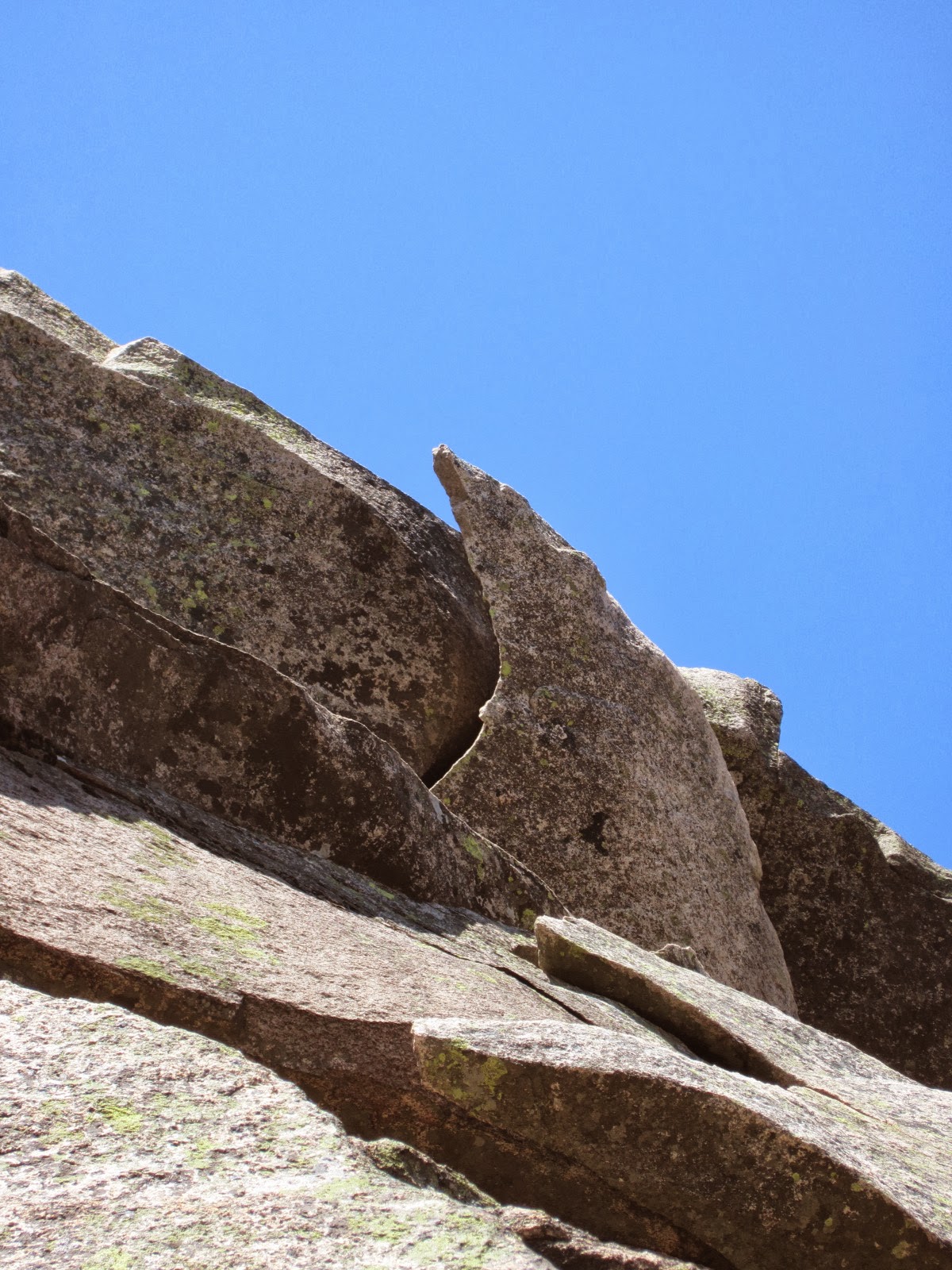
The next pitch breaks right through some blocky terrain in a right facing corner.  A steep layback tops the corner and a gear belay can be built.  From here the climb works up and right aiming for the Finger of Fate.  The finger is a unique feature that looks like a giant shark fin, about 20' tall.  It appears to be a flake wedged into the cliff.  I led the pitch to the base of this crazy fin.  This pitch climbs a right facing corner in a slab.  The corner ends at a long horizontal roof.  A thin traverse leads right to another unique feature.  The Sickle is a sword like horizontal flake that can be slung as natural gear before pulling a mantel up and over it.  Great friction properties and solid gear make this pitch a lot of fun.
The Sickle and The Finger of Fate
 The Finger can be pulled on either side.  Neither has any protection unless you happen to have a Big Bro handy.  Luckily, the lip is a massive jug and a leg can thrown up and over the flake.  If someone wanted to up the excitement they could campus all the way to the top before pulling over the Finger.  However, a fall on lead from here would be at the very least an ankle buster.  There is another unprotected 5.6 move as you step back to the main cliff from the Finger on slab.  This is in the realm of R rated climbing but shouldn't be a problem if you have made it this far.

On top of the Finger of Fate

 The next pitch begins 30' left across the ledge at a manky looking crack.  A small cam and a then a #3 Camalot protect a V2 boulder move that gets you off the deck.  Above the climbing was a little wet but much easier.  This leads to another belay ledge.  A pillar that forms a left facing corner can be seen up and left.  There is a cave in the middle of the corner.  A bit of delicate friction climbing leads to the base of the corner.  A steep layback gets you into the cave.  I was on lead and clipped into a fixed tricam and one of two nuts that we ended up getting as booty.  A blind reach for a jug, followed by committing moves lead to a strenuous exit from the cave and onto the crack riddled face above.  Another classic pitch.  From here Lukasz led us out the standard finish.  This pitch is supposed to be 5.6 but its just as hard as the other 5.8 pitches throughout the entire route.

Finally we topped out!  The climb ends up on a huge, flat rock ledge with amazing views of Franconia Notch and the surrounding mountains and rock faces.  A great place to relax, take the shoes off and grab a bite to eat.  From here one heads climbers right and follows the cliff line down towards a small helipad.  A trail is followed from here down past where the Old Man of The Mountain used to sit.  The old metal turnbuckles that held him on are still in place, dangling over the side of the cliff.  The trail winds back down to the lake and eventually the climber parking lot after about an hour.  What a day.
Time to get out of Dodge


Flat ground, Way up High, Great View, Nasty Feet
Partner in Climb

Some Technical Information:

Car to Car :  About 10hrs
Rack : Full set of Nuts, Set of C3s, Double rack of C4s #.3-#3, One #4 Camalot, Lots of slings

I think the grade of 5.8 is fair when I think about other climbs of the grade I am used to in NY.  The climb is not very strenuous.  Only when pulling the Triangle roof did I feel a little pump.  I think being confident in the friction of the granite and having well rounded climbing skills is the key to getting up efficiently and having fun.  Moby Grape requires hand and foot jamming, steep laybacking, pure friction, and mantling.  We both found that with a decent hand hold our feet were solid on any angle of the granite.  Makes for fun and creative moves.  All of the hardest moves are really well protected but there are a couple spots of R rated climbing and quite a bit of PG, especially where ledges come into play in the event of a fall.  There are a couple spots where the rock is dangerously loose.  There is a death block under the Triangle roof that needs to go.  It is hard to trundle, I'd imagine, on such a popular route.  But overall, this is a five star classic climb in a gorgeous setting on a badass cliff.  Both of us would go back and climb it again tomorrow.


Monday, March 4, 2013

Backcountry Ice Climbing: AMG


Avalanche Mountain Gully
 
 
Avalanche Lake Panorama

Over the last few weeks Lukasz has been mentioning, on a daily basis, that he wants to hike into Avalanche Pass and do some ice climbing.  I felt like this would be a good experience.  I was up for a big day with a long approach, and an adventurous route.  I'm brand new to ice climbing and just bought ice tools about a month ago.  I have gotten out a handful of times, following friends on mostly WI4 climbs and even leading some easier lines.  Lukasz saw AMG (Avalanche Mountain Gully WI 4-) from across the lake while climbing the Trap Dyke last March, and has been set on climbing it since.


AMG

 
This picture was taken in March of 2012 with AMG in much fatter conditions than this year.  A recent trip report on Mountain Project indicated mixed conditions on the final pitch, which I think served to psyche Lukasz up even more.

Lucasz, Jackie and I began our day from the ADK Loj and followed well broken, moderate trails 5 miles in to Avalanche Lake.  An approach like this made us all wish we owned cross country setups, as skiers were constantly cruising by while we slogged our way in.  Weather conditions were fair.  The sky was 100% overcast with light snow falling on and off.  The temperature started in the mid 20s and dropped as we gained elevation.  The saving grace was the lack of wind which made the whole day a comfortable experience.

The Promised Land!
 
 
The route proper is approached from the west side of Avalanche Lake in between the wooden bridges (hitch up Matildas).  The first few hundred feet are a slow, steep wade, through deep snow slopes. 
 
The lower gully snow slopes
 
There is a short step (25') just below the actual climb.  This can be handled on easy WI3 to the left, or if you are feeling like a challenge, at its steepest section, which was fragile WI4.  Lukasz led this harder section and we all agreed at the end of the day that it was the pumpiest climbing we had done.  Given a second go, we would opt to take the easier path over and get to the main event above.
 

Beginning AMG
 
AMG's first pitch ascends increasingly steep ice, joining the huge left facing corner and continuing to an interesting cave belay.  The climbing is enjoyable and views of Avalanche Lake and the Trap Dyke make the setting of this climb very impressive.  We all had the feeling of doing something big in the mountains.  The acoustics of this area are strange.  Jackie and I could hear the crunch of footsteps and casual conversation of skiers hundreds of feet below us on the lake but communication with Lukasz above was nearly impossible, except for rope tugs.
 
Near the top of P1
 
Everyone made it to the cave without  incident. It was a little cramped for the three of us so I anchored in long with the rope and hung out on the small snow slope in front of the cave.
 
Jackie in the Cave
 
I was half scared and half psyched looking from the cave up the second pitch.  I had no doubt Lukasz would find a way to the top, and it just looked so cool.  What troubled me a bit was the giant free hanging curtain guarding the top out.  This pitch is near vertical right out of the cave, then eases up a bit in angle.  This leads to a thin mixed traverse behind the curtain and then up and over the fragile, barely attached ice to the top.  Lucasz did some serious whooping and sang the Polish versions of several classic rock tunes as he was clearly enjoying the climbing above.
 
 Leaving the cave. 
Hanging Curtain
 
As it turns out the climbing wasn't quite as difficult as I thought it would be.  There were great stances all the way up and the mixed traverse was exciting and interesting.  I'm finding that mixed sections really allow for a lot of creativity.  Lukasz and Jackie both made short work of the traverse, taking a low path and creeping up what turned out to be a short curtain of ice that was actually attached to the rock. 
Happy Jackie Sender
 
I on the other hand, made this traverse a bit more interesting.  I ended up climbing higher, all the way up to the roof.  After looking at the terrain I decided I was going to use a nice jug and just one tool.  Lukasz, who was belaying just to my right, was not giving me a single word of beta even though he saw me doing things differently.  I really appreciate this actually.  There is nothing worse than a climbing "coach" trying spray you down when you prefer to figure things out for yourself.  I thought I had clipped my second tool to my harness but I realized I had not when it began flying through the air, bouncing 300ft down the gully.  OOPS.  Luckily, my beta worked and I got through, topping out with one tool.
 
Missing a tool
 
Success!!! We spent a couple minutes on top celebrating and then it was time to get the flock out of there.  Three double rope rappels got us back to Avalanche Lake. We donned our headlamps for the last two as darkness was setting in.  Another two hours and we had dispatched the five miles of hiking back to the Jeep.  We ended up being out there from 9am until 9pm. A big day.  Absolutely worth it. One of the best days I've spent in the ADK backcountry.  Thanks Lukasz and Jackie. It was a blast!
 
Lukasz has a face.
 
Also: Special Thanks to Stewart's for hot dogs, chili, and, of course, coffee.